
- This event has passed.
Central Asia at the Crossroads
May 12 @ 12:00 AM – 1:30 PM
Connectivity, Critical Minerals, and the Future of Regional Sovereignty
Central Asia is undergoing its most significant strategic realignment since independence. The five post-Soviet republics — Kazakhstan, Kyrgyzstan, Tajikistan, Turkmenistan, and Uzbekistan — are increasingly behaving as a coordinated bloc, signing mutual trade targets, harmonizing border arrangements, and engaging external partners through the C5+1 format and its emerging variants. At the same time, the region sits at the heart of three intersecting global pressures: the competition for critical minerals, the redrawing of Eurasian trade corridors, and the security spillovers from a permanently unstable Afghan-Pakistani frontier.
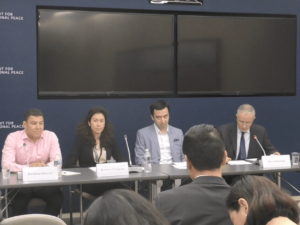
This panel brings together leading practitioners and scholars from the New Lines Institute, the World Bank, and Nightingale International for a focused conversation on what Central Asia’s next decade requires — from regional governments, from the United States, and from international partners. The discussion will examine the New Lines Institute’s “Silk Seven Plus” (S7+) framework, the durability of recent C5+1 commitments, the structural barriers to intra-regional trade, and the climate, water, and security risks that could derail integration if unaddressed.
Lunch will be served. The event is open to in-person attendees on the 6th floor of the New Lines Institute and to a virtual audience via livestream.
Speakers:
Moderator: Dr. Dania Arayssi is a Senior Analyst at the Central Asia Center of the New Lines Institute for Strategy and Policy, where her work focuses on regional political economy, governance, and U.S. policy toward Greater Central Asia. She also serves as an Adjunct Assistant Professor at Georgetown University’s Edmund A. Walsh School of Foreign Service and teaches Comparative Political Economy at George Washington University. Her recent co-authored work has examined how regional frameworks such as S7+ can anchor Central Asia’s economic sovereignty while addressing shared challenges in water, energy, and trade infrastructure.
Panelists:
Dr. Azeem Ibrahim, OBE is the Chief Strategy Officer at the New Lines Institute and the principal architect of the institute’s Silk Seven Plus (S7+) framework — a diplomatic initiative that envisions Central Asia, together with Afghanistan and Azerbaijan, as a connected economic bloc capable of asserting regional sovereignty against coercive dependence on China and Russia. He is also an Adjunct Research Professor at the U.S. Army War College’s Strategic Studies Institute and a columnist at Foreign Policy. He completed his PhD at the University of Cambridge and has held fellowships at Harvard’s Kennedy School and Yale.
Sobir Kurbanov is an international development professional with over two decades of experience advancing economic governance, institutional reform, and regional cooperation across Central Asia and Eurasia. His technical expertise spans macroeconomic management, public sector governance, digital development, trade and private-sector development, and policy evaluation, complemented by a strong record in program design, results-based management, and donor coordination.Sobir has held senior roles with the World Bank Group, the UK Department for International Development (DFID), the Center for International Private Enterprise (CIPE), and the Swiss Cooperation Office, where he helped design and implement complex, multi-country programs on governance, including digital and ICT, competitiveness, and regional integration. His work has informed key World Bank and donor strategies and contributed to landmark initiatives such as Digital CASA and the B5+/C5+1 regional economic cooperation platform. He has authored and contributed to numerous publications and policy studies on Central Asia’s political economy, trade, and regional integration, including works published by the CAREC Institute, CIPE, and the George Washington University Central Asia Program. His research has explored macro-economic reforms, external financing, labor migration, cross-border value chains, and the evolving role of the private sector in transition economies. Most recently, Sobir has been supporting the World Bank’s Central Asia Jobs and Green Economic Transformation study, leading stakeholder consultations, private sector engagement, and validation processes across the region. In parallel, he has contributed to analytical work on returning migrants and labor market dynamics in Central Asia, including rapid assessments linking migration, jobs, and social resilience in fragile and high-risk areas.
Sobir holds an MSc in Economic Management and Policy from the University of Strathclyde (UK) and has taught courses on industrial policy and public policy reforms at the OSCE Academy and George Washington University, blending academic rigor with extensive field-based policy experience.
Dr. Muneeza Mehmood Alam is a Senior Infrastructure Economist at the World Bank, with extensive experience across the Europe and Central Asia, Middle East and North Africa, and South Asia regions. She joined the World Bank in 2015 and has since worked at the intersection of transport economics, policy reform, and operations, helping countries translate analytics into impactful investments and reforms. Her work spans economic corridors and regional connectivity, railways and logistics, inclusive urban mobility, gender-responsive transport, and low‑carbon transport transitions. She has co-led major lending operations—including large-scale railway and economic corridor programs—and has played a central role in shaping national transport strategies, regulatory reforms, and cross-border connectivity agendas. A consistent theme of her work is understanding how transport investments can more effectively support jobs, productivity, and inclusion. Muneeza is also an active contributor to the World Bank’s global knowledge agenda. She has led and authored flagship analytical and research outputs on regional railways, transport corridors, and gender and mobility, and regularly engages in multi-partner initiatives and cross-practice collaboration to advance integrated development solutions. Before joining the World Bank, she worked in economic consulting in Washington, DC. She holds a PhD in Economics from Yale University.
Justin Burke is a veteran journalist with more than 35 years of experience and the founder of Eurasianet, an independent news outlet covering the former Soviet Union and broader Eurasia region. He began his career as a CBS News intern during the 1980 political conventions, then worked for NBC News and TBS before joining the Associated Press in 1987 as a general news reporter in Detroit. From 1990 to 1993, he served as the Christian Science Monitor’s Moscow correspondent, covering the collapse of communism and the early warlord period in Afghanistan, and later headed the Monitor’s Germany bureau, where he reported on the EU and NATO’s post-Soviet evolution. After a year as a visiting scholar at Harvard’s Davis Center for Russian and Eurasian Studies (1995–96), Burke joined the Open Society Institute in New York, where he launched Eurasianet in 1999. He served as managing editor until late 2017 and now holds the role of publisher and executive director. In 2016, Eurasianet became an independent organization hosted by Columbia University’s Harriman Institute, and the site earned a Webby nomination the following year. Also in 2017, Burke joined Columbia’s School of International and Public Affairs as a lecturer focused on communications. He holds a BA in Soviet Studies from Boston University and has authored academic work on Russian internal migration and Ukrainian state-building.